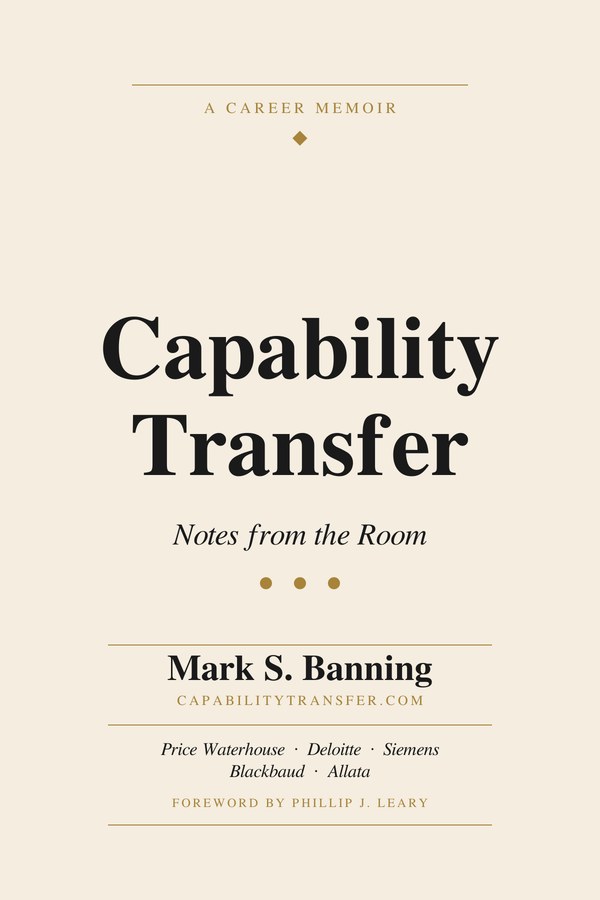
I started writing this book because I wanted to share what I learned. Forty years in rooms where the work was real — at Price Waterhouse, Deloitte, Siemens, Blackbaud, and Allata — produces a kind of knowledge that doesn't transfer through training programs or methodology decks. It transfers through stories, careful ones, told by someone who was actually in the room. I wrote Capability Transfer to put those stories in the hands of practitioners coming up after me, so they wouldn't have to learn what I learned the hard way.
The book is a career memoir, but it's not a memoir in the conventional sense. The personal material is grounded — there's a chapter about growing up in Dilley, Texas, what my family taught me about work, and how those early frames shaped how I show up in professional rooms. The opening section pulls together what made me. But most of the book lives in specific operational situations: tutoring college algebra to students who'd been told they couldn't do the math, the hallway encounter at ExecuTrain that started everything, the Top Secret A-12 Avenger training program, the Mall Around America Tour, the Best and Brightest. Each chapter walks through a particular situation, what was at stake, what I did, what worked, what didn't, and what I'd do differently now.
The longest chapter is about Blackbaud. I came in to a training organization that wasn't working — what I came to call the "taxi stand mentality," where instructors were assigned to teach whatever class needed coverage, regardless of whether they knew the material. Eighteen months later the function had grown from $12M to $22M with margin improvement, not through any silver-bullet intervention but through a series of careful moves I describe in detail. The young trainer sent to Oklahoma City to teach material she didn't know, alone in a classroom in front of paying clients, in tears. The senior leader who yelled before he investigated. The CEO whose theatrical approach to layoffs reshaped how I think about leadership transitions. The Blackbaud chapter is essentially a case study told through the people involved, including specific decisions that turned out to matter more than I knew at the time.
The book closes with a chapter called What It All Comes Down To — my attempt to synthesize forty years into the principles that actually held up. The central distinction the book turns on, which became the title, is between knowledge transfer (which happens easily and often) and capability transfer (which is hard, rare, and what the work is actually about). Most training organizations spend their energy on knowledge transfer and wonder why their graduates can't perform. The book is one practitioner's argument, illustrated through career-long evidence, that the difference matters and that capability transfer is achievable when you understand what it actually requires.
The foreword is by Phillip J. Leary, COO of Allata, who watched me run a version of this work in his own organization and agreed to vouch publicly for what he saw. His foreword does work I couldn't do for myself — naming, from outside, what the methodology produces when it's done with care.
Throughout the book, key decisions get marked with callouts. Coined concepts I've developed across my career — the harvest curve, the architectural state, the failure taxonomy, the collaborative facilitation method — appear in context, with daggers pointing to a glossary at the back where each is defined. The book is meant to be read straight through if you want the narrative arc, or referenced selectively if you want a specific situation or concept.
Who is the book for? Anyone running a training organization or a customer-facing capability function and feeling that what they're doing isn't quite working. Anyone considering taking on that kind of role. Anyone trying to develop people whose work matters and finding that conventional approaches don't produce the depth they need. The book doesn't promise transformation. It offers the honest accumulation of one practitioner's experience, in case it's useful.
It's free. Take it.